

賢伉儷蒞臨芝加哥做多場的講演,大眾報以熱烈的掌聲!.jpg)


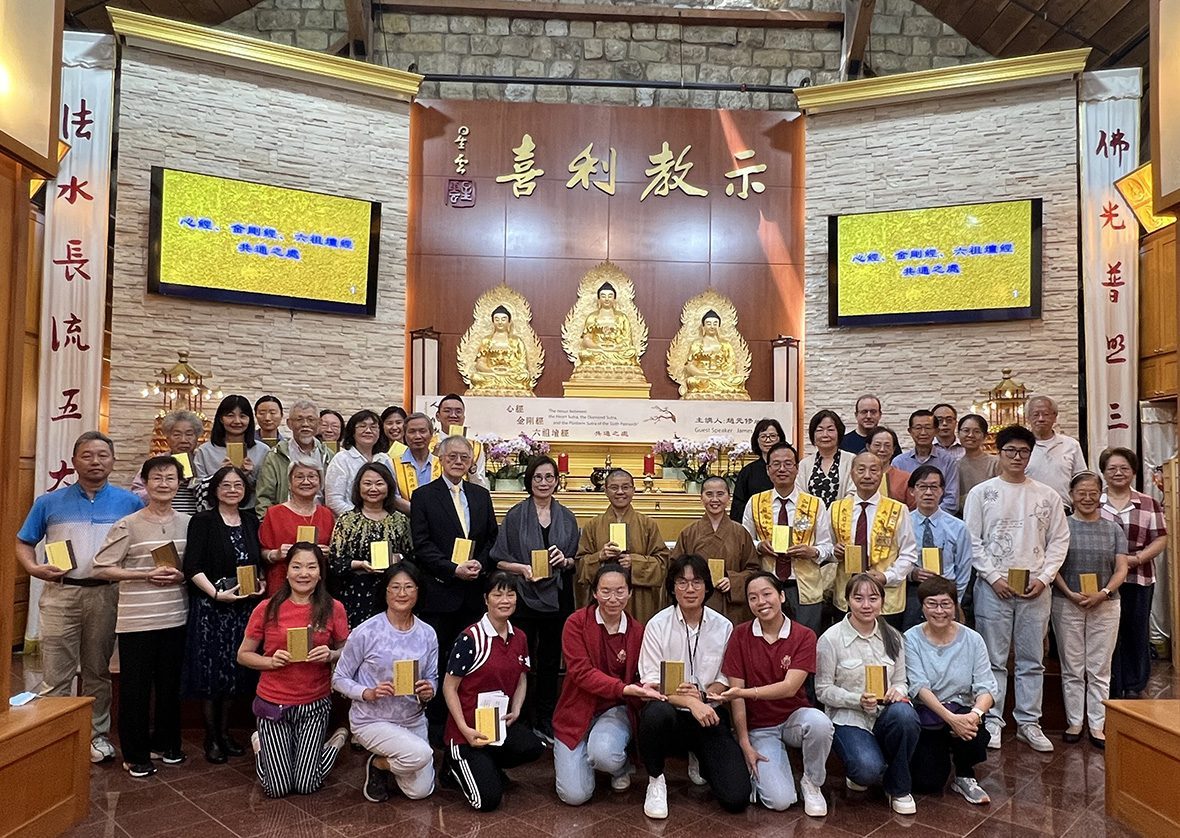


On the morning of June 9, the BLIA Chicago Chapter hosted a Dharma lecture at the Fo Guang Shan Chicago Buddhist Temple. The keynote speaker was George Chao, a BLIA Lay Dharma Lecturer and General Representative of Fo Guang Shan Lay Devotees. His topic focused on the commonalities between the “Heart Sutra,” the “Diamond Sutra,” and the “Platform Sutra of the Sixth Patriarch.” Venerable Yung Han, Head Priest of Fo Guang Shan Chicago, joined nearly 60 participants and friends to listen to the insightful presentation.
George Chao introduced the Buddha’s journey to enlightenment, the compilation of the sutras, and the spread of Northern and Southern Buddhism. He emphasized the teaching that “all phenomena with form are illusory.” He explained that a Buddha is an enlightened human being and that everyone possesses Buddha-nature. If we can eliminate greed and attachment, we can realize our true nature, which aligns perfectly with Venerable Master Hsing Yun’s Humanistic Buddhist concept of “I am a Buddha.” He suggested that the audience utilize the “Hearing, Contemplation, and Practice” method to uncover their inherent Buddha-nature.
Discussing the connection between the “Diamond Sutra” and the “Platform Sutra,” George Chao pointed out that since the Fourth Patriarch, the “Diamond Sutra” has been used to directly realize one’s nature and attain Buddhahood. He noted that all phenomena are inseparable from self-nature—meaning the original mind is pure. The “Platform Sutra” teaching of “abiding nowhere while giving rise to the mind” is directly derived from the “Diamond Sutra.” He used the concept of the “Threefold Emptiness of Giving” (no giver, no gift, and no receiver) to illustrate “non-abiding.” He encouraged everyone to follow the Three Seals of Dharma, the Four Noble Truths, and the Noble Eightfold Path in their daily cultivation.
Regarding the practical stages of cultivation, Mr. Chao noted that the first line of the “Heart Sutra” points out the key: to “contemplate.” This means gaining deep understanding, which is the path leading to awakening. One must develop meditative concentration (Samadhi), which gives rise to wisdom (Prajna). He introduced the stages of practice found in the “Diamond Sutra” logical structure: “A is X, is not X, therefore is named X.” This reflects the transition from the level of ignorance to the level of awakening—analyzing, dissolving, and reorganizing surface knowledge to reach complete understanding. This corresponds to the “Three Turnings of the Dharma Wheel” (indicative, encouraging, and witness) and the practice of Hearing, Contemplation, and Practice.
He concluded by quoting the Sixth Patriarch’s realization: “How unexpected! The self-nature is fundamentally pure… fundamentally self-sufficient… and capable of giving rise to all phenomena,” encouraging all to have confidence in their potential.
Following the lecture, the audience responded with enthusiastic applause, grateful for Mr. Chao’s eloquent synthesis of the three classics. Chapter Superintendent Mai-Ping Chou reflected that realizing “self-nature” is realizing “Buddha-nature,” and by practicing the Three Acts of Goodness, one can “overcome all suffering.” Third Subchapter President Bao-Xi Du noted that the “Song of Formlessness” in the “Platform Sutra” teaches how to practice the Six Perfections in daily life, proving that “heaven is right before our eyes.” To conclude the event, George Chao gifted participants copies of the Dunhuang version of the “Diamond Sutra with Commentary by the Sixth Patriarch,” leaving everyone filled with Dharma joy.