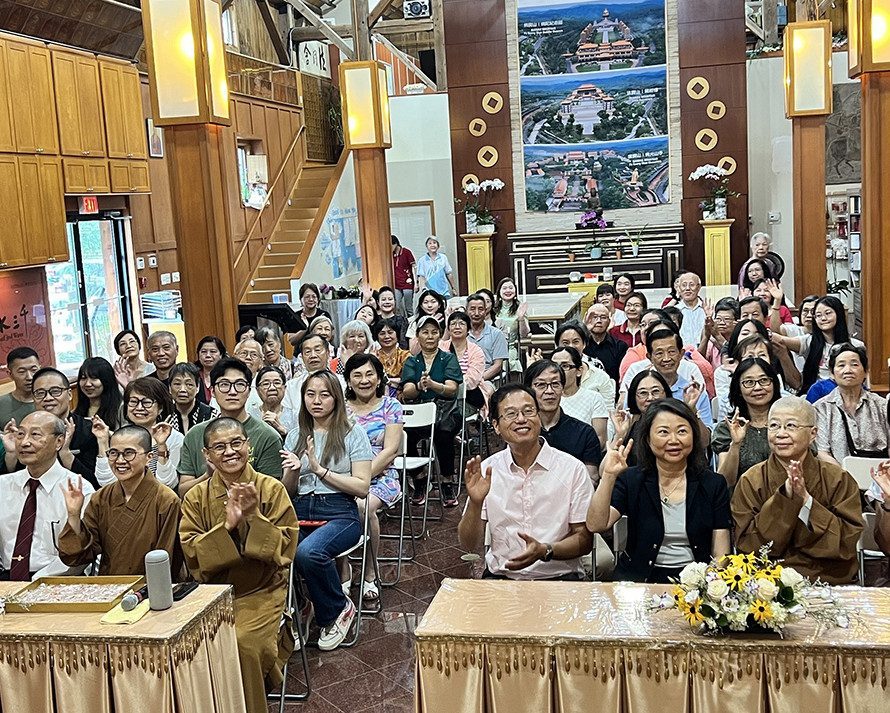


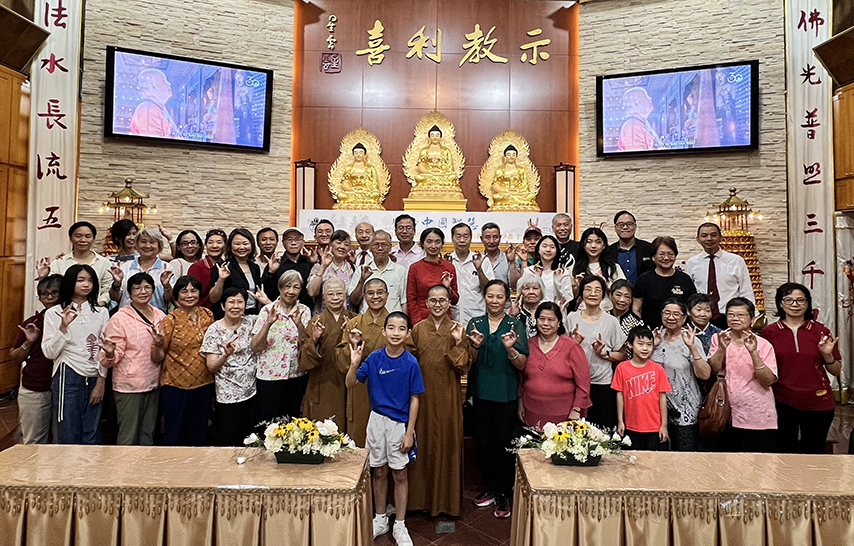


Professor Yu Dan from Beijing Normal University delivered a profound online lecture titled “Insights into Chinese Wisdom” for the devotees of Fo Guang Shan Chicago. Known for her deep erudition in traditional culture and her ability to articulate complex ideas with clarity and grace, Professor Yu provided an inspiring session for nearly 100 participants.
The event opened with a warm welcome from Ke-Ying Wang, President of the BLIA Chicago Chapter. Professor Yu began her talk by tracing thousands of years of Chinese cultural heritage, emphasizing the concept that “all phenomena are created by the mind,” a principle that aligns perfectly with Buddhist teachings. Drawing from Venerable Master Hsing Yun’s early experiences as a novice at Dajue Temple, she reflected on the importance of transcending binary, “black-and-white” thinking. She encouraged the audience to face all circumstances with direct responsibility and to practice the “Three Acts of Goodness”: Do good deeds, speak good words, and think good thoughts.
Professor Yu remarked, “Before enlightenment, a Buddha is a sentient being; at the moment of enlightenment, a sentient being is a Buddha.” She noted that heaven and hell exist within a single thought. While we cannot control every event in our global village, we can adjust our mindsets and practice the “Four Givings”—giving hope, confidence, joy, and convenience. By fostering mutual respect and tolerance, we can collectively create a peaceful world and achieve a fulfilled life.
Discussing the Confucian “Three Universal Virtues,” she explained that all life’s challenges are ultimately impacts upon the heart. Only by observing one’s own heart can one realize their true nature and stay far away from “distorted dream-thinking.” Quoting the Buddhist proverb, “When a single thought of anger arises, a million obstacles open,” she urged the audience to guard their hearts and practice self-reflection to achieve a life of self-respect.
Using the first chapter of The Great Learning—”Knowing where to rest, one achieves stability; with stability comes tranquility; with tranquility comes peace; with peace comes deliberation; and with deliberation comes attainment”—Professor Yu illustrated how a firm will leads to calmness and wisdom. She noted this mirrors the Buddhist “Threefold Training” of Morality, Meditative Concentration, and Wisdom (Sila, Samadhi, and Prajna), which serve as the antidote to greed, anger, and ignorance.
During the sharing session, Dr. Meng Shen observed that Professor Yu’s interpretation of Confucianism (doing one’s duty), Taoism (harmony between nature and humanity), and Buddhism is the very practice of Humanistic Buddhism. Professor Deng Zongsheng from Nanhua University was moved by her use of philosophical stories to inspire the realization that “one is a practitioner when enlightened, but a prisoner when deluded.” Mrs. Lai-Ying Li, visiting from abroad, felt most inspired by the strategy of “taking up” responsibilities with Confucian wisdom, “letting go” of fame with Taoist wisdom, and “opening the mind” with Buddhist wisdom.
Chapter Superintendent Mai-Ping Chou expressed the assembly’s gratitude, noting how Professor Yu internalized the Master’s “Three Acts of Goodness, Four Givings, and Five Harmonies” into accessible wisdom. In conclusion, Head Priest Venerable Yung Han thanked Professor Yu for her sharing, and YAD President Karen Wang presented a virtual bouquet of flowers, looking forward to their next meeting.