

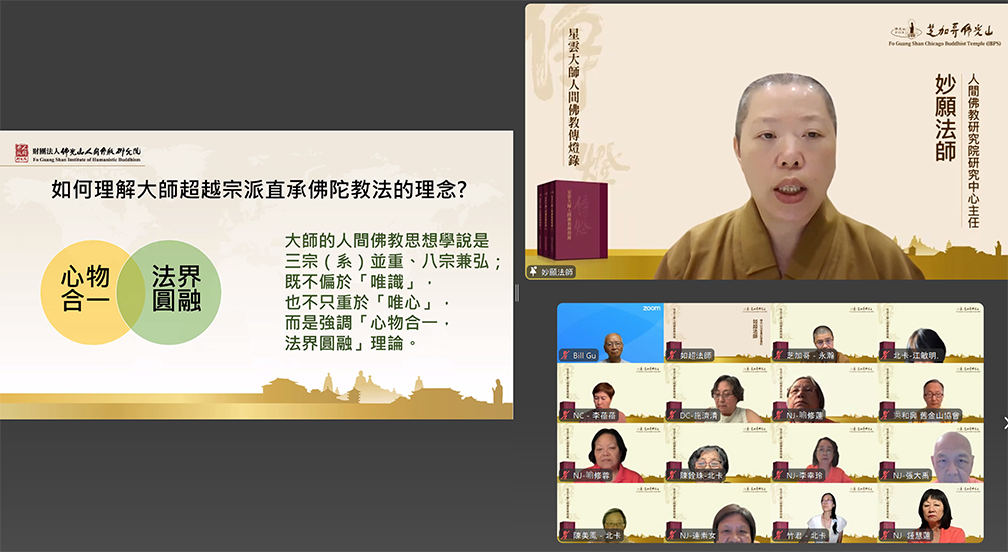


The third session of the seminar series on the book The Transmission of the Lamp: Venerable Master Hsing Yun and Humanistic Buddhism, organized by Fo Guang Shan Chicago, was held online on June 27. The session featured Venerable Miao Yuan, Director of the Research Center of the Institute of Humanistic Buddhism, and Venerable Ru Chao from the Secretariat Office, with Venerable Yung Han, Head Priest of Fo Guang Shan Chicago, serving as the moderator. Nearly 100 BLIA members from Chicago, North Carolina, New Jersey, Detroit, and across the East Coast gathered online to share in the Dharma joy.
Venerable Miao Yuan presented on Chapter 5, “The Integration of Buddhist Culture, Knowledge, and Faith.” She elaborated on the modern significance of the “New Fo Guang Classification of Teachings,” which emphasizes the integration of the Sravaka and Bodhisattva vehicles, the harmonious promotion of the eight schools of Chinese Buddhism, and the mutual respect and cooperation between the three major Buddhist traditions (Theravada, Mahayana, and Vajrayana). She pointed out that Venerable Master Hsing Yun’s new classification centers on the “original intent of the Buddha,” aims for “integrated Buddhism” as a direction beyond sectarianism, and uses “Humanistic Buddhism” as the practical guide.
Following this, Venerable Ru Chao provided a reading guide for Chapter 10, “Methods of Practice for Modern Life.” She guided the audience to integrate faith, morality, and practice into daily living, introducing the three types of cultivation proposed by Venerable Master Hsing Yun: “Religious Life,” “Moral Life,” and “Humanistic Life.” The Venerable encouraged the assembly to seize the present moment and practice through their speech, actions, and mental attitudes.
Venerable Yung Han expressed her gratitude to the two speakers for their accessible yet profound explanations—one focusing on theory and the other on practical methods. Over the course of three weeks, the series has systematically explored the essence of Humanistic Buddhism, moving from theory to practice and from historical integration to modern life. Chapter 1 outlined the theoretical framework; Chapter 2 showed how the Master moved from concept to action; Chapters 5 and 6 presented a vision of integration and transformation; and Chapter 10 brought the teachings into the routine of daily life, guiding practitioners to realize that “life is practice.” These seminars were not only about studying a text but served as a reflection on and elevation of one’s life.
During the sharing session, several participants offered their reflections. Xing-Ling Li, a Superintendent of the New Jersey Chapter, thanked the speakers for helping the audience quickly grasp the core principles of Humanistic Buddhism. Jin-Xing Chen, a Director of the Detroit Chapter, shared that he was deeply inspired by how the Master reconstructed a Buddhist system for contemporary society by tracing back to the original thoughts of the Buddha.