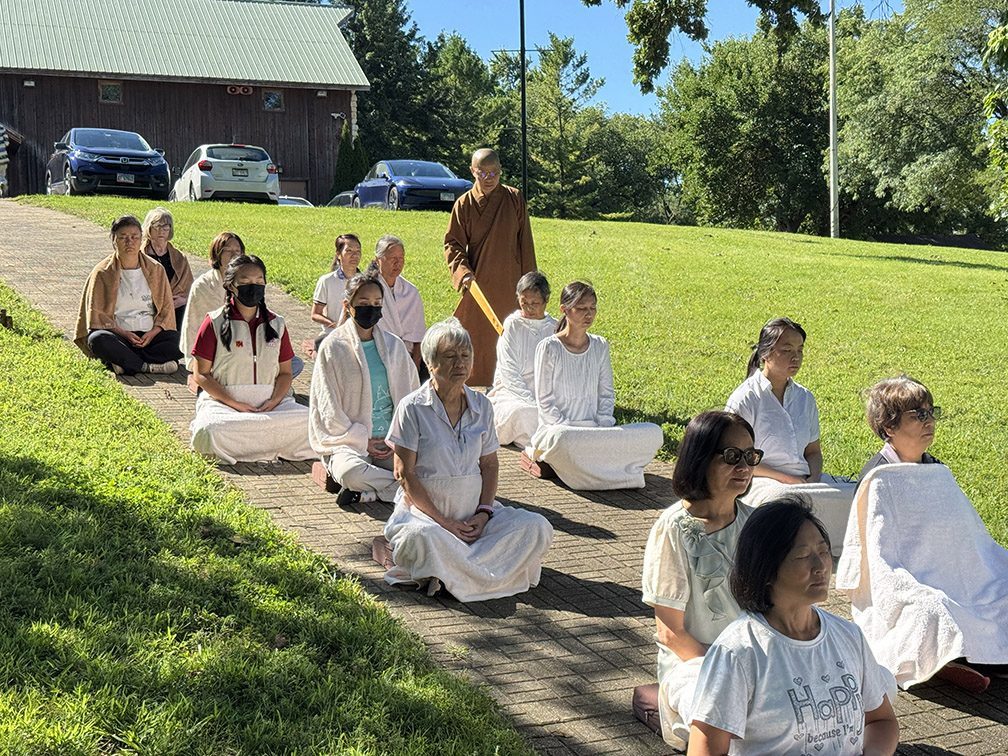


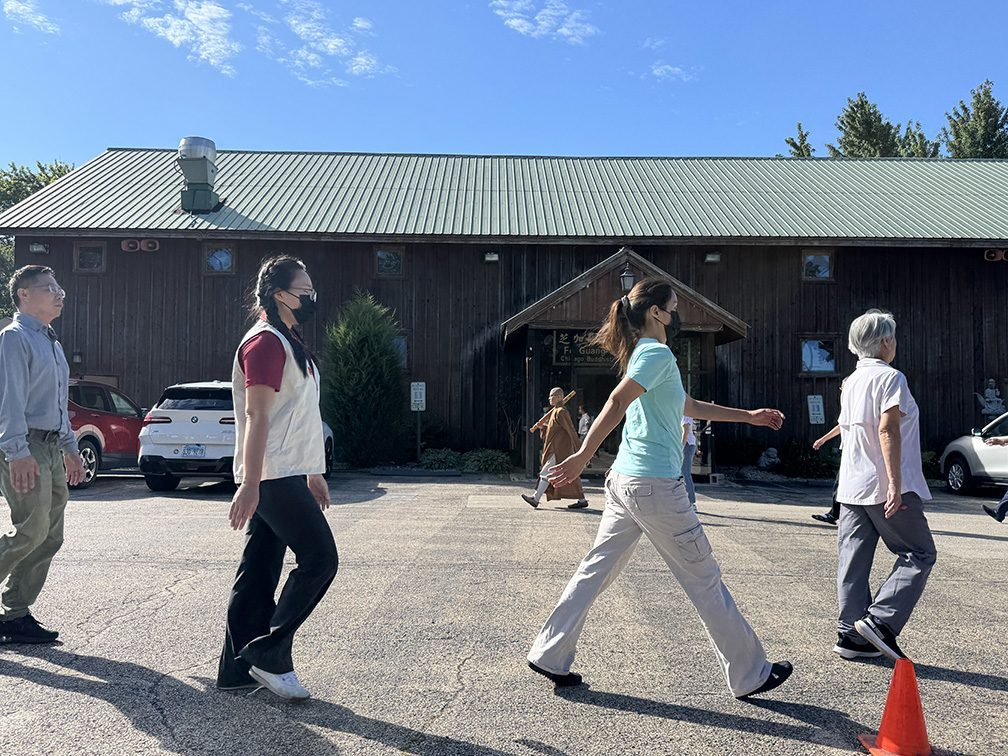


Fo Guang Shan Chicago organized three sessions of “Summer Meditation Classes” this year, culminating in a “Half-Day Meditation Retreat” on August 24. Participants relaxed their bodies and minds through seated meditation, walking meditation, and outdoor practice, learning the spiritual wisdom of “bringing the body and mind back to the present moment.” Led by Head Priest Venerable Yung Han, students learned how to implement “Humanistic Life Zen” into their daily lives. The four-session series attracted nearly 100 participants from both Chinese and English-speaking backgrounds, with simultaneous translation provided.
The activity began with students choosing a comfortable cross-legged position based on their physical condition, followed by a meditation experience that included posture adjustment, breath counting, and the practice of the “Four Foundations of Mindfulness” (Body, Feeling, Mind, and Dhamma). During the outdoor meditation session in the temple’s Zen garden, participants practiced observing their six sense faculties, maintaining focus and tranquility amidst the sounds of traffic and nature.
Venerable Yung Han quoted the Platform Sutra of the Sixth Patriarch: “Affliction is Bodhi; birth and death is liberation,” reminding the assembly that spiritual practice lies in transforming one’s perspective and letting go of calculations. She inspired the group with a Zen master’s dialogue: “You can be liberated at any time; so who is tying you down?” emphasizing that what usually traps us are our own inner afflictions. By constantly observing one’s mind, one can experience sudden enlightenment and enter “liberation through wisdom.”
The Venerable explained that “Humanistic Life Zen” is closest to the original intent of the Buddha’s Humanistic Buddhism, which is why Venerable Master Hsing Yun named the Fo Guang meditation practice as such. It emphasizes integration into daily life—walking, standing, sitting, and lying down are all Zen. It is about maintaining awareness in the moment and tempering the mind through daily affairs. Practicing just five minutes of mindful breathing each day can help one maintain clarity amidst busyness and noise, cultivating a calm and composed attitude toward life.
Several participants shared their reflections. Chicago Chapter President Ke-Ying Wang stated that meditation brought his thoughts back to his breath, improving his focus and helping him find purity in a busy schedule. Vice President of the Third Subchapter, Dao-Xuan Zhang, recalled her experience of tranquility at the Manila temple during her childhood. Member Xiu-Zhao Cai mentioned that walking meditation made her more mindful in daily life. Youth members Ya-Lan Yang and Yi Mao, attending for the first time, enjoyed the outdoor meditation and felt a sense of oneness with nature. Participant Hai Yin noted that based on her understanding of the Heart Sutra, meditation is the best practice for not being swayed by external environments.
In conclusion, the Venerable reminded the assembly that following the meditation methods taught by the Buddha is the most reliable path. Rather than seeking supernatural responses or practicing blindly, one should find a quiet heart through breath counting and mindful awareness.